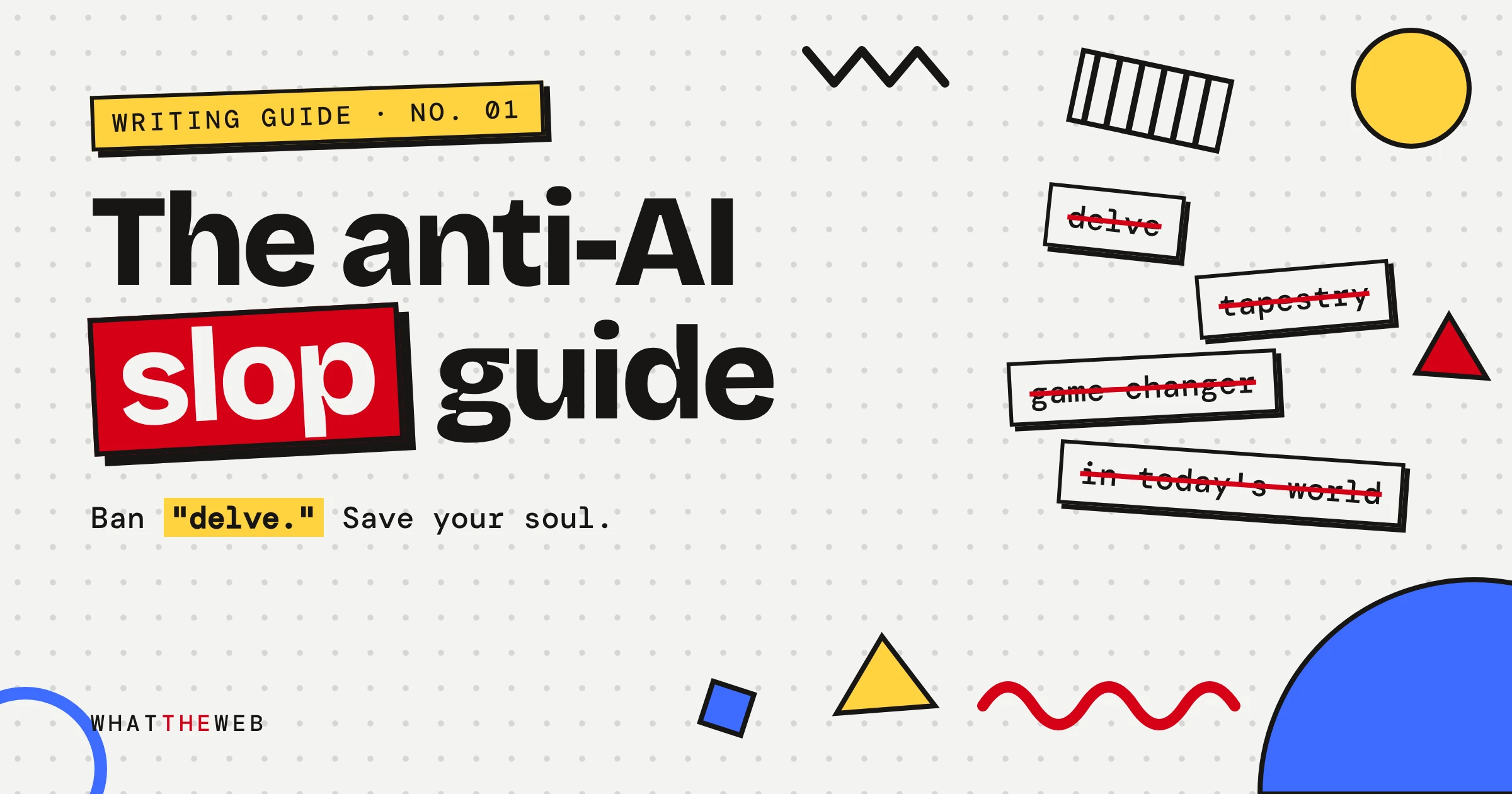
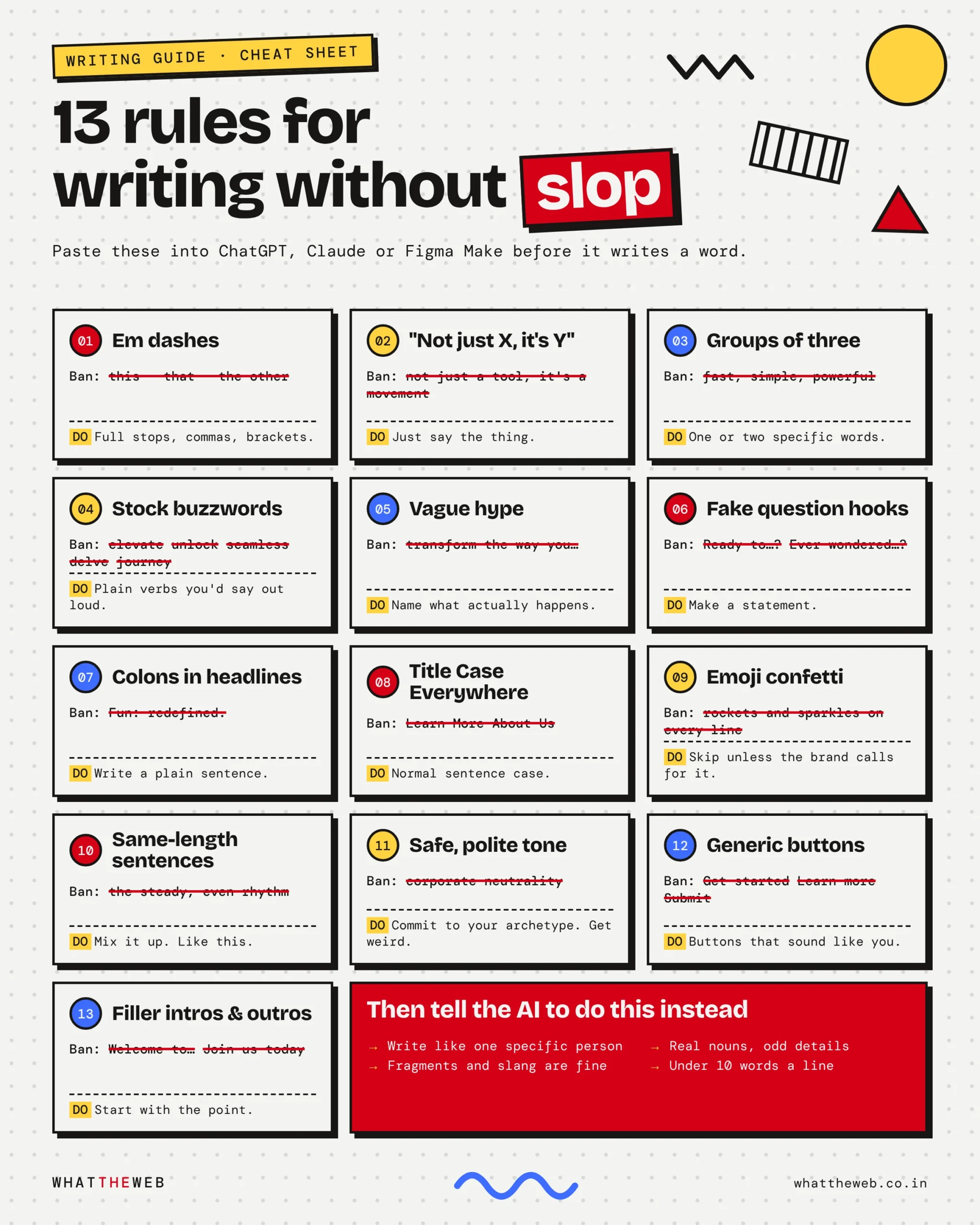
To humanize AI text and avoid AI slop, ban the patterns AI defaults to. That means em dashes, “not just X, it’s Y” lines, lists of three, buzzwords like “elevate” and “seamless,” and fake-question hooks. Then tell the AI to write like one specific person, with real nouns and odd details. Below are 13 rules you can paste straight into ChatGPT, Claude or Figma Make. For the search-side version of this, see our guide to AEO content writing.
What is AI slop?
AI slop is content that sounds like nobody wrote it. It’s polished, polite and forgettable. Readers spot it in seconds now. So do editors. And so do the AI answer engines deciding which pages to cite. Google does not ban AI writing, however. Its guidance on AI-generated content rewards usefulness over the method. In other words, slop fails because it is unhelpful, not because a model wrote it.
The fix isn’t to stop using AI. It’s to stop letting AI pick for you. In short, you still have to make the calls.
13 AI slop habits to ban when you humanize AI text
Each rule below is a line you can hand straight to the model. Together they humanize AI text faster than any rewrite pass, because they strip the defaults out before the draft exists.
1. Em dashes
Ban: The long dash AI drops into every other sentence. Do instead: Use full stops, commas or brackets.
2. “Not just X, it’s Y”
Ban: The fake contrast trick. Do instead: Just say the thing.
3. Groups of three
Ban: “Fast, simple, powerful” style lists. Do instead: Use one or two specific words. Real lists have the number of items the content actually has.
4. Stock buzzwords
Ban: elevate, unlock, seamless, empower, journey, delve, game changer, next level, curated, effortless. Do instead: Use the plain verb a person would say out loud.
5. Vague hype
Ban: “Transform the way you…” and “Experience the future of…” Do instead: Name what actually happens.
6. Fake questions as hooks
Ban: “Ready to…?” and “Ever wondered…?” Do instead: Make a statement.
Notice that every rule so far is a deletion. That alone will humanize AI text a long way, since most slop is additive.
7. Colons in headlines
Ban: “Fun: redefined.” Do instead: Write a plain sentence.
8. Title case everywhere
Ban: Every Word Capitalized On Buttons And Headings. Do instead: Use normal sentence case.
9. Emoji confetti
Ban: Decorative emoji sprinkled through the copy. Do instead: Skip them unless the brand truly calls for them.
10. Same-length sentences
Ban: The steady, even rhythm AI loves. Do instead: Mix very short lines with longer ones. Like this.
11. Safe, polite tone
Ban: Corporate neutrality. Do instead: Commit to your brand archetype fully, even if it’s weird.
12. Generic buttons
Ban: “Get started,” “Learn more,” “Submit.” Do instead: Write buttons that sound like the brand talking.
13. Filler intros and sign-offs
Ban: “Welcome to…” and “Join us today.” Do instead: Start with the point.
What to tell the AI instead to humanize AI text
Banning slop only gets you halfway. Give the model a voice to aim for:
- Write like one specific person talking, not a brand committee.
- Use concrete details, odd specifics and real nouns.
- Fragments and slang are fine.
- Keep every line under 10 words, unless it’s body copy.
- For a jester brand: real jokes, self-roasts, breaking the fourth wall.
How to humanize AI text in practice
Start with the ban list, because a model needs a boundary before it needs a style. Then give it a voice to copy. Finally, read the draft aloud. If a line sounds like a press release, rewrite it. For example, swap “elevate your workflow” for whatever the thing actually does on a Tuesday.
Interfaces carry the same tells, so it helps to audit the design side as well. Moreover, Google’s people-first content guidance asks the same question a good editor asks: would anyone miss this page if it vanished?
More on how to humanize AI text
- AEO Content Writing: 11 Rules to Sound Human
- Design Tools That Will Make Your Apps Look Anti-AI Slop
- 8 Unexpected Things We Shipped With Figma Make
Copy-paste anti-slop prompt
Write this copy following these rules.
Never use: em dashes, "not just X, it's Y", lists of three,
the words elevate, unlock, seamless, empower, journey, delve,
game changer, next level, curated, effortless.
No "transform the way you", "experience the future of",
"ready to", "ever wondered", "welcome to", "join us today".
No colons in headlines. Sentence case only. No decorative emoji.
No "Get started", "Learn more" or "Submit" buttons.
Vary sentence length. Commit to the brand voice: [ARCHETYPE].
Write like one specific person. Use real nouns and odd details.
Under 10 words per line unless it's body copy.
FAQ
How do you humanize AI text?
Ban its default patterns in the prompt, then give it a specific human voice. Read the output out loud and cut anything you wouldn’t say.
What words make content sound AI-generated?
Common giveaways include delve, elevate, unlock, seamless, leverage, journey and game changer.
Why do em dashes signal AI writing?
Models overuse them as an all-purpose connector. Real writers mix in full stops, commas and brackets.
Does AI slop hurt SEO and AEO?
Generic copy gives search and answer engines nothing unique to cite. Specific, opinionated content is more likely to get picked up.
Can I use these rules in Figma Make?
Yes. Paste the prompt block above into Figma Make, ChatGPT or Claude before you generate microcopy.