AEO content writing means writing so an answer engine can lift a clean answer straight off your page. Not a ranking, but a quote.
As a result, that shift hits writers hardest. ChatGPT, Perplexity and Google’s AI Overviews answer the reader before anyone clicks. So padded intros, long wind-ups and passive sentences now cost you traffic you used to win by default.
This guide fixes that. You get the voice, structure and ending moves that make crypto content easy for humans to read and easy for machines to cite. Every example below comes from crypto writing, but the rules travel.
What is AEO content writing?
Answer engine optimization (AEO) is the practice of structuring an article so AI search tools can extract, quote and credit a single answer from it.
SEO asks one question: will Google rank this page? Meanwhile, AEO asks a different one: will an answer engine quote this sentence?
However, you need no special markup for it. Google states there are no extra requirements to appear in AI Overviews or AI Mode, and no AEO-only schema to add (Google Search Central). In short, clear and quotable writing does the work.
Why does AEO matter for crypto writers right now?
Crypto readers ask narrow questions. Why are gas fees high today? Is staking taxable in India? Which wallet should a beginner pick?
Answer engines love those questions. In fact, they pull one clean sentence and move on. So AEO content writing rewards the writer who answers in sentence one. The writer who opens with “in the ever-evolving world of blockchain” loses it.
How do you make your writing sound human?
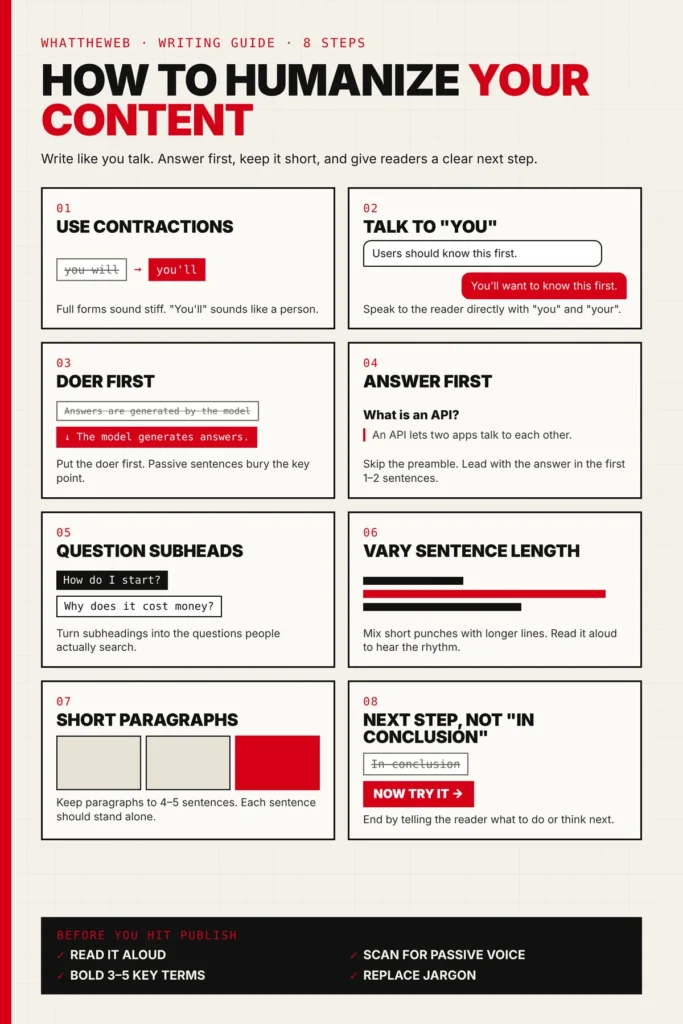
- Use contractions everywhere. Write “you’ll,” not “you will.” After all, full forms sound stiff.
- Talk to the reader. “You need to understand smart contracts” beats “beginners should understand smart contracts.”
- Write like you speak. If you wouldn’t say it out loud to a friend, rewrite it.
- Read every sentence aloud before you publish, because your ear catches what your eye skips.
- Add small moments of personality. Example: “Your first crypto trade will probably terrify you. That’s normal.”
How do you switch passive sentences to active ones?
Put the doer first. Then the action. Then the thing acted on.
- Passive: “Smart contracts are executed by the blockchain.” Active: “The blockchain executes smart contracts.”
- Passive: “Bitcoin was created by Satoshi Nakamoto in 2009.” Active: “Satoshi Nakamoto created Bitcoin in 2009.”
- Passive: “Gas fees are charged by the network.” Active: “The network charges gas fees.”
Active sentences also run shorter. They also survive extraction, because an engine can quote them without rebuilding the sentence first.
What should you avoid in AEO content writing?
- Vague openings. Jump straight to the answer. Answer engines skip preamble.
- Over-explaining. Your reader searched one specific problem, so solve that one.
- Passive constructions. “X is done by Y” buries the actor and the meaning.
- Fancy synonyms. Say “use,” not “utilize.” Say “help,” not “facilitate.”
- Walls of text. Engines quote single sentences, so each sentence has to stand alone.
- The “in conclusion” wrap-up. Better endings come later in this guide.
How should you structure an AEO article?
- Ask the question, then answer it. “What is a smart contract? It’s self-executing code that runs on a blockchain.”
- Write subheadings as questions. “How do I buy Bitcoin?” “Why do gas fees exist?” Engines index subheadings heavily.
- Front-load the takeaway. Put it in the first sentence or two. Don’t bury the lede.
- Keep sentences under 20 words. Short sentences parse and cite cleanly, so engines can quote them whole.
- Use numbered and bulleted lists. Three reasons Bitcoin matters: decentralized, immutable, borderless.
- Bold three to five key terms per section, because bolding flags the concepts you want pulled.
How do you keep AEO writing interesting?
Structure gets you cited. However, rhythm keeps the human reading. So good AEO content writing does both at once.
- Vary sentence length. One word. Then a medium line. Then a longer one that builds to a payoff.
- Use analogies sparingly. “Bitcoin is like digital gold” lands once. Five times, it patronizes.
- Add why it matters. Smart contracts remove the middleman, so you save time and fees.
- Break dense sections with a question. “But what happens if the code has a bug?”
- Use specifics. “Bitcoin crossed $70,000 in March 2024” beats “Bitcoin is valuable.”
- Name the common mistake. Most beginners think gas fees are fixed. In reality, they aren’t.
How should you end an article instead of “in conclusion”?
Kill the formal wrap-up. Instead, pick one of these five endings.
- The next step. “Now that you understand smart contracts, explore Ethereum’s dApps.”
- The solution. Circle back to the opening problem. “You came here confused about gas fees. Now you know they move with demand.”
- The future focus. “Bitcoin is the start. Altcoins, DeFi and staking come next.”
- The reflection question. “Can you see why decentralization matters now?”
- Validation plus momentum. Tell the reader their confusion is normal, then point them forward.
Each one hands the reader an action, whereas a summary hands them nothing. Strong endings are where AEO content writing earns the next click.
How do you write AEO content for Indian readers?
AEO content writing for India needs local signals, because answer engines also weigh location. If you write for an India-focused publication, say so in the writing itself.
- Reference local context where it fits: Indian exchanges, the RBI’s stance on crypto, Indian crypto tax rules.
- Use local analogies. UPI changed how India pays. Blockchain is doing that to settlement globally.
- Flag regional differences. US crypto rules differ from Indian ones, so tell readers to check local law.
- Weave in natural phrases like crypto in India or Indian crypto exchanges. Weave, don’t stuff.
The AEO content writing checklist to run before you publish
- Read it aloud. Does it sound like you talking to a friend?
- Check your contractions. Every full form needs a reason to exist.
- Scan for passive voice. Rewrite any sentence where the doer comes second.
- Count sentence lengths. Mix short, medium and long.
- Check your subheadings. Are they questions that match search intent?
- Bold three to five key terms per section.
- Check your opening. Does it answer immediately, or stall?
- Check your ending. Next step or reflection, never a summary.
- Break any paragraph longer than four or five sentences.
- Test your examples. Specific beats generic every time.
- Scan for jargon. Swap in the simple word.
AEO content writing FAQs
Is AEO replacing SEO?
No. Instead, AEO sits on top of SEO. Your page still has to get indexed and still has to earn a snippet before an answer engine can quote it. Google’s people-first content guidance still sets the floor.
How long should a sentence be for AEO?
So aim for under 20 words. That is because long sentences hide the answer inside clauses, and engines quote the shortest complete statement they can find.
Does AEO content writing need special schema?
No. Schema helps search features, but Google confirms no AEO-specific structured data exists. Clear question-and-answer structure does more for you than any markup.
Your next step
First, take your current draft. Run it through the AEO content writing checklist above, once, before you publish. As a result, you’ll cut a third of the words and keep all of the meaning.
Want to speed that pass up? Start with the AEO tool you didn’t know you need. And if your drafts still read like a machine wrote them, the same fix works on other formats too, as in writing AI video prompts that don’t sound like AI.